Why do people trust what an AI recommends?
By Bjorn Vandemeulebroucke · author of Become the Answer
I'm Bjorn Vandemeulebroucke, managing partner of a Word of Mouth Agency and author of Become the Answer. For over twenty years my work has been getting real people to recommend brands. Now that AI does the recommending, I measure and improve how brands show up in its answers.
The trust
It isn't a new kind of trust.
It is word of mouth, at scale.
Four qualities make an AI recommendation feel like advice, not marketing.
The trusted oracle shifted from neighbor to search to machine; the impulse never changed.
Because it behaves like a trusted friend, not a salesperson. It answers your exact question directly, appears to have no stake in the outcome, and speaks in one confident voice as if it has read everything. That combination, neutral, effortless, and sure, is what people have always trusted.
It is worth being precise about this, because the trust is real and it is reshaping who gets bought, even though the machine is often confidently wrong.
Four things make an AI recommendation feel trustworthy.
The first is that it reads as neutral. There is no banner ad, no sponsored label, no salesperson working an angle. Whether or not that neutrality is fully deserved, the absence of a visible incentive makes people lower their guard. It feels like advice, not marketing.
The second is confidence. Search handed you ten options and made you the judge. An AI hands you a conclusion, in one steady voice, with a reason attached. We are wired to read confidence as competence: a doctor who hesitates worries us; one who is sure reassures us. The AI never hesitates.
The third is effort, or the lack of it. It answers your exact situation, in your own words, instantly. Convenience and trust are close cousins: the thing that makes a decision easy earns credit for making it well.
The fourth is the sense that it has read everything. When an AI recommends a brand, it feels like the distilled verdict of the whole internet, every review, every forum, every comparison, delivered as a single sentence. That is the wisdom of the crowd, wearing one calm face.
Notice what all four have in common. They are the exact qualities we have always trusted in a person: a friend with no stake, who is sure, who makes it easy, who seems to know what everyone thinks. The AI is not inventing a new kind of trust. It is borrowing the oldest one, word of mouth, and wearing a neutral, tireless face.
For a brand, that has a hard edge. You cannot argue your way onto that list, and you cannot buy your way on with an ad the machine ignores. The trust the AI passes to a brand is really the trust other people already placed in it, in their reviews, their recommendations, their honest words online. The machine only relays it. Which means the work is not to persuade the AI. It is to be genuinely worth the recommendation it is already reading.
- Consumer shift
Want to know where your own brand stands in AI answers?
More from AEO Foundations
The shift
The buyer stopped researching.
Now they just ask.
The decision moves inside a single AI conversation you'll never see.
Has AI changed how people decide what to buy?
The buyer stopped researching a list; they ask, and act on the answer.
- Consumer shift
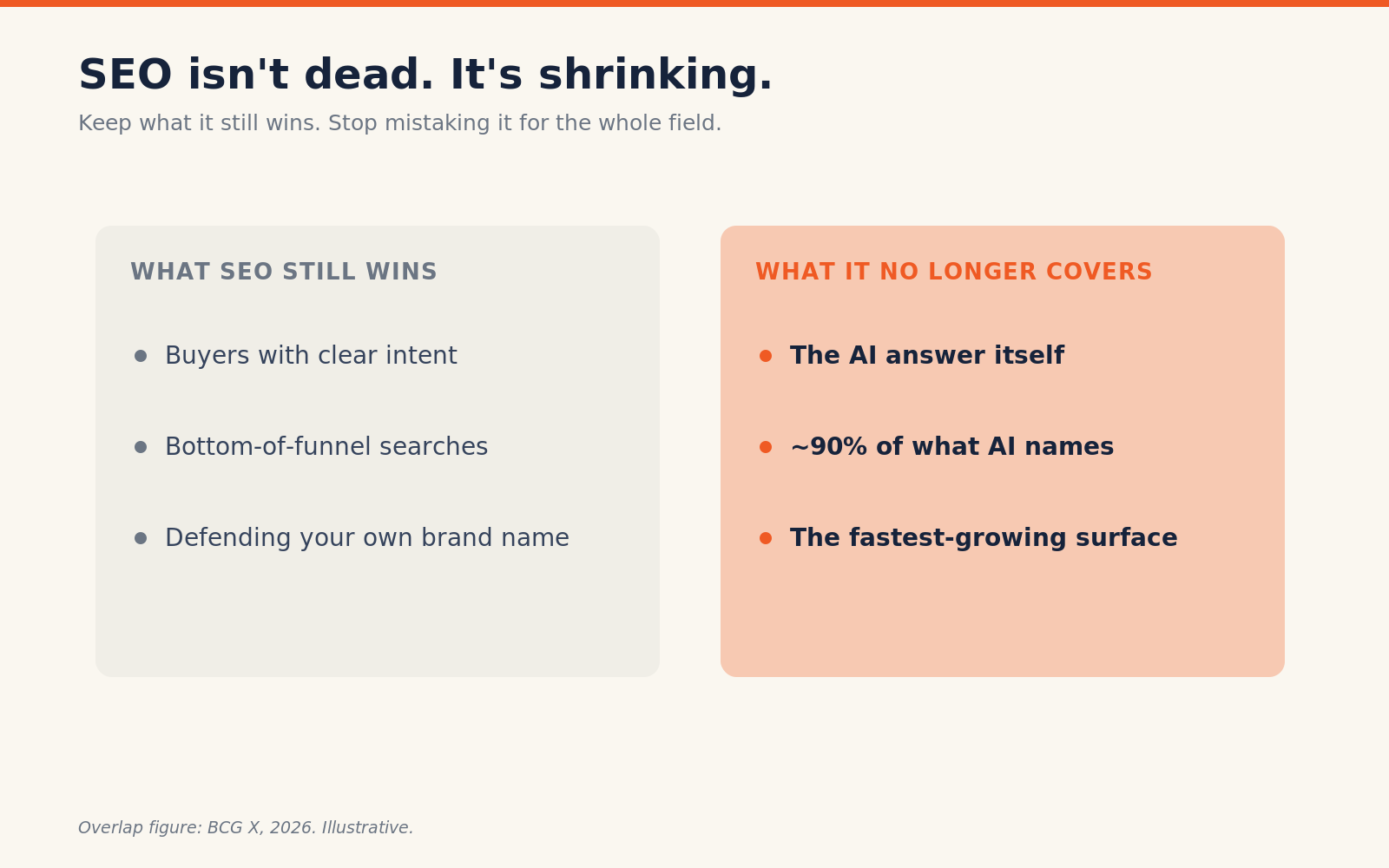
Is SEO dead, or just shrinking?
The honest answer: search isn't dead, but AI answers and search overlap by only 8 to 12% (BCG X).
- System shift
The funnel
The funnel didn't disappear.
It collapsed into one moment.
And most of that moment is dark to your analytics.
What happened to the marketing funnel in the age of AI?
The journey collapses into one recommendation moment.
- Consumer shift